held in the street

the murals watched. we didn’t march fast. we took up space. our orange shirts carried what couldn’t be said.
Writings from the shore between tides, ni tout à fait la terre ni tout à fait l'eau.
the murals watched. we didn’t march fast. we took up space. our orange shirts carried what couldn’t be said.

this city loves a moral lesson in spray paint.

pink sky, mesh shirt, keffiyeh on the straps. joy is not the absence of struggle. it’s what we carry through it.

pride is protest. still.

we lay down because they can’t.
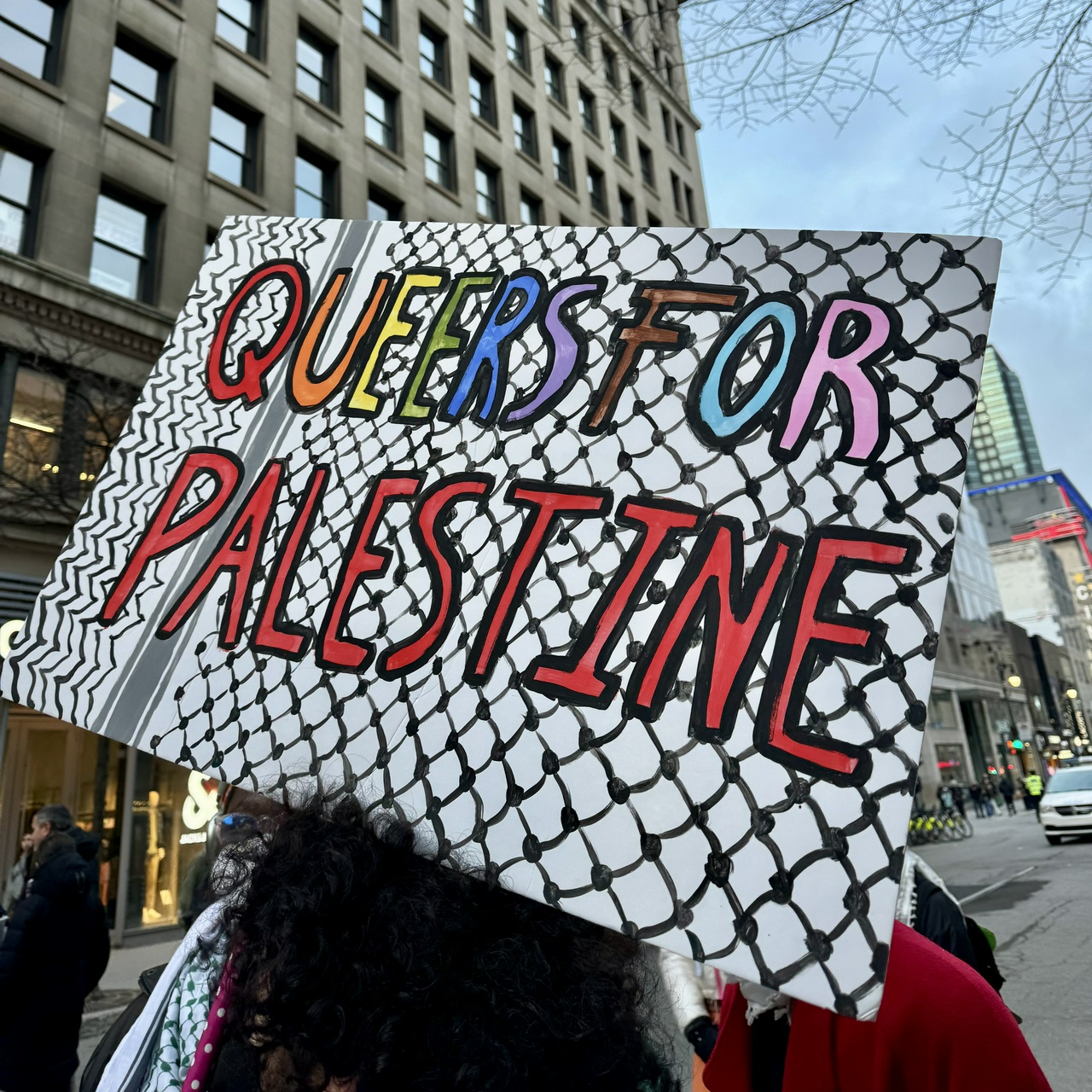
this was a die-in. healthcare workers, gathered in the middle of the city, bodies on the ground for gaza. we were there not just as clinicians, not just as queers, not just as people trained to care— but as witnesses to a system that pretends to be neutral while choosing a side. we already knew that silence wasn’t an accident. we’ve seen it before—in the wards, in the media, in the funding reports. but still, there’s something about laying your body down on cold ground that makes the grief feel sharper. and makes the refusal feel real.
my keffiyeh wasn’t a symbol. it was a practice. a reminder. a commitment to name genocide where others equivocate. to be present when presence costs something.
the pink triangle on my chest traced a line back to act up, to queer resistance in the face of state abandonment. but this wasn’t about metaphor. this was about gaza. about children buried under rubble. about medics killed in white coats. about naming what we know, and what our institutions refuse to say.
i didn’t speak. i didn’t need to. sometimes protest is not what you say but what you don’t move to stop.

we stood still when the sun disappeared. a crowd without urgency. no one tried to name it.
the air changed first— cold, metallic, like something was watching. then the sky, folding into dusk as if the day had given up early.
i didn’t feel awe. not exactly. more like a shared breath held too long.
some people clapped when the light came back.
but most just stood there. under bare trees. on stolen land. watching a hole in the sky remind us how small we are.
 after the burnout.
after the heart palpitations.
after the kind of anxiety that makes your body forget itself—
i left.
after the burnout.
after the heart palpitations.
after the kind of anxiety that makes your body forget itself—
i left.
no email. no calendar. just this. water on my thighs. sun on my shoulder. a queer resort where no one needed me to explain why i came.
i didn’t heal. not fully. but i stopped bracing.

i looked up and didn’t try to name any of them.
constellations directions just stars— scattered, distant, alive.
i don’t always need meaning. sometimes it’s enough to know something else is out there.
something beyond what this world keeps asking me to carry.
“Every breath for a Black person is a grace in a world hell-bent on stealing our lives whether by actual execution or by the slow burn of dehumanization. But the awesome truth is, none of the villains in that oppression narrative are the givers of that grace. They have no real power over our breath even when trying to rob us of it. We must consciously continue to breathe because it is a demonstration of our defiance. Doing so allows us to birth ourselves over and over again, into every iteration of our people's freedom journey, and that, I suspect, must be terribly frustrating for our oppressors. And yes, be cause they are not the ones who can give us life, they absolutely have no right to steal it. Knowing this is the ultimate resistance. It is what Harriet knew. It's what Nat and Fannie Lou knew.”
— Tracey Michae’l Lewis-Giggetts, Black Joy: Stories of Resistance, Resilience, and Restoration, pp. 12-13